
Dear reader,
Hope you are doing well. Are you wondering what are the secret weapons we humans have built for ourselves for Greener Farming? Are you ready? Buckle up and get ready and read along. Yes, we have built ourselves some secret weapons for Greener Farming!
Sustainable agriculture is farming in sustainable ways to meet our society’s food and textile needs, without compromising the future generation’s ability to meet their needs. It can be based on an understanding of the ecosystem services as there are multiple methods to increase the sustainability of agriculture. Flexibility is key while developing agricultural business processes within the sustainable food systems for farming practices. Agriculture has an enormous environmental footprint, playing a significant role in causing climate change, water scarcity, water pollution, land degradation and deforestation.
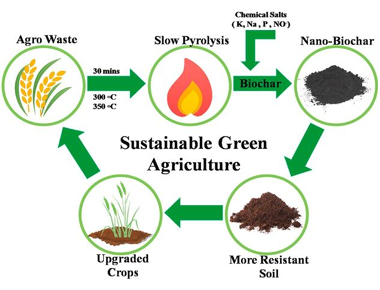
Biochar and hydrochar are both carbon-rich materials produced from organic biomass and are gaining attention for their potential in environmental management sustainable agriculture.
Biochar is created through pyrolysis, a thermal decomposition process carried out in the absence of oxygen. It is known for its porous structure, high stability and effectiveness in improving soil fertility, sequestering carbon pollutants.
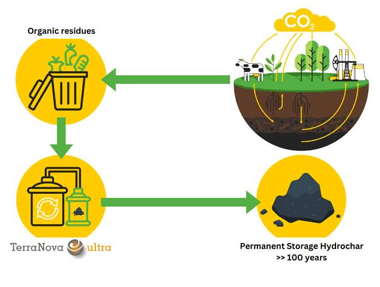
Hydrochar, on the other hand, is produced via hydrothermal carbonization, a process that involves heating wet biomass in water under pressure at relatively lower temperatures (180 250°C). This method mimics natural coal formation and yields a material with different physicochemical properties compared to biochar, often richer in oxygen-containing functional groups and with better potential for use in wet systems or energy applications.
Both materials offer promising avenues for waste management, soil enhancement and carbon capture, but differ significantly in production methods and end-use characteristics.
The Earth-Changing Benefits: Advantages in Soil and Beyond
The initial excitement around biochar centred on its role as a soil amendment, a powerful tool for soil restoration and improving fertility. The benefits are numerous and impactful:
- Improved Soil Structure and Water Retention: Its high porosity creates large surface areas, which significantly increase the soil’s water holding capacity. This means plants can access water for longer, especially crucial in drought-prone areas. Studies have shown increased porosity when chars are used as soil amendments (Wagner and Kaupenjohann, 2014).
- Enhanced Nutrient Retention and Availability: Soil nutrients can be notoriously fleeting, easily leaching away with rain or irrigation. Biochar acts like a magnet, preventing this loss. Its cation and anion exchange capacity means it can hold onto vital nutrients like nitrates and ammonium as well as phosphorus and potassium making them more available for plants to absorb. This is a game-changer for plant nutrition, as adding biochar can increase nutrient uptake efficiency, especially when combined with mineral fertilizers.
- Boosting Plant Growth and Health: The cumulative effect of better water and nutrient retention often translates to healthier, more robust plants. Biochar can increase plant root biomass, as seen in maize under field conditions (Abiven et al., 2015). For nursery plants, studies have shown positive impacts on growth.
- Waste Management and Circular Economy: In a world grappling with mounting waste, biochar and hydrochar offer a brilliant solution. They transform organic wastes that might otherwise end up in landfills (producing methane, a potent greenhouse gas) into valuable resources that are conserved, inputs are minimized, and waste is seen as a raw material for something new.
- Microbial Ecosystem Support: The porous nature of biochar provides excellent habitats for beneficial soil microbes, further enhancing soil health and nutrient cycling. All that is good but commercial and industrial biochar production takes place in specialized pyrolysis plants or biomass gasification facilities. These plants are located worldwide, often near biomass sources such as agricultural or forestry residues and can be extremely expensive.
Now consider replacing biochar with peat that promotes nutrient recovery and use efficiency. This aligns perfectly with the concept of a circular economy, where resources are conserved, inputs are minimized, and waste is viewed as a raw material for new, sustainable products. In recent years, coco peat (also known as coir pith), derived from coconut husks, has emerged as a highly effective and sustainable alternative to both peat and biochar in horticultural and agricultural applications. Coco peat offers several advantages that are driving its growing adoption:
- Renewable and Abundant: Unlike biochar, which requires pyrolysis of biomass and can be energy-intensive, coco peat is a byproduct of the coconut industry and is abundantly available in tropical regions. Its production uses waste material that would otherwise be discarded, making it a true circular economy product.
- Superior Water Retention and Aeration: Coco peat has excellent water-holding capacity—often surpassing biochar—while maintaining good aeration, which is critical for healthy root development. This makes it ideal for seed starting, potting mixes, and soil conditioning.
- Neutral pH and Nutrient-Friendly: Coco peat has a near-neutral pH and does not introduce excessive carbon or alter soil chemistry drastically, unlike some biochars which can be highly alkaline or variable depending on feedstock and production conditions.
- Biodegradability and Environmental Safety: Coco peat is fully biodegradable and compostable, breaking down naturally without leaving harmful residues. This contrasts with biochar, which is more stable and persists in soil for longer periods— an advantage for carbon sequestration but sometimes less desirable for short-term horticultural use.
- Cost-Effectiveness and Availability: In regions where coconuts are grown extensively, coco peat is often more cost-effective and readily available than biochar, which may require specialized production facilities.
Because of these benefits, many growers and horticultural industries are increasingly turning to coco peat as a sustainable growing medium and soil amendment, effectively replacing biochar in applications where immediate water retention, aeration, and biodegradability are prioritized. While biochar remains valuable for long-term soil carbon sequestration and improving soil structure over time, coco peat’s versatility and eco-friendly profile make it a preferred choice in nurseries, organic farming, and commercial horticulture.
In summary, coco peat complements and in some cases replaces biochar by offering a renewable, efficient, and environmentally sound alternative that supports sustainable agriculture and waste valorization, further advancing the goals of a circular economy.
Here is a comparative analysis table between Coco Peat and Biochar based on their properties, uses, and environmental impact:
| Feature / Aspect | Coco Peat | Biochar |
| Source | Byproduct of coconut husks (coirindustry) | Charcoal-like material from pyrolysis of biomass in oxygen-limited environment |
| Physical Properties | Fibrous, lightweight, high porosity, holds 8-9 times its weight in water | Highly porous, carbon-rich, large internal surface area with thousands of pores |
| Water Retention | Excellent water retention, holds moisture for extended periods, better than peat moss | Increases water holding capacity, especially in coarse or degraded soils |
| Aeration | Provides great aeration and oxygenation, preventing soil compaction | Improves soil aeration and reduces soil penetration resistance |
| pH Level | Neutral to slightly acidic (pH 5.0 6.8), suitable for a wide range of plants | Can increase soil pH (alkaline), varies depending on feedstock and production |
| Nutrient Retention | Stores and slowly releases nutrients, supports nutrient use efficiency | Retains nutrients and can bind heavy metals and toxins, reducing leaching |
| Biodegradability | Slowly biodegradable, lasting around 10 years or more | Very stable, can persist in soil for hundreds to thousands of years |
| Environmental Impact | Renewable, uses agricultural waste, reduces peat extraction and associated greenhouse gases | Carbon sequestration potential, reduces greenhouse gas emissions, but production is energy-intensive |
| Uses in Horticulture | Growing medium for seed starting, potting mixes, hydroponics, soil conditioning, worm bedding | Soil amendment to improve fertility, water retention, pollutant remediation, carbon sequestration |
| Disease Resistance | Natural antifungal and antibacterial properties | Provides habitat for beneficial microbes but may affect herbicide efficacy if misapplied |
| Reusability | Can be reused up to 4 years in growing media | Typically incorporated into soil permanently |
| Cost & Availability | Widely available in coconut growing regions, cost-effective | Production requires pyrolysis facilities, cost varies with feedstock and processing |
| Additional Applications | Used in mushroom farming, bonsai mixes, turf farming, landscaping | Used in water/air filtration, livestock feed additive, construction materials, renewable fuel |
So thus, Coco Peat is favoured for its excellent water retention, aeration, neutral pH, biodegradability and most importantly for its economical price, making it ideal for horticulture, especially as a peat moss substitute. It is renewable and derived from agricultural waste, supporting sustainability.
Biochar excels in long-term soil improvement, carbon sequestration, nutrient retention, and pollutant remediation but is less biodegradable and requires energy-intensive production. It is valuable for enhancing soil structure and mitigating climate change through carbon storage. Both materials contribute significantly to sustainable agriculture and waste valorisation but serve somewhat different roles depending on the specific horticultural or environmental goals.
So, do you agree with me? The real secret weapon for greener farming really is cocopeat, emerging to save this world from the waste material of our humble coconut. And that is a full cycle of the coconut tree emerging from the soil to bring out the fruit and the waste of the fruit is processed to be coco peat that goes back into the soil to help you grow more fruits and vegetables!
Now that we have established that Peat is the way to go, for pete’s sake let us turn this conversation to how you are using it and if you are not, what are you going to do include it in your farming needs?
Ofcourse a customary thank you from me to you for reading this. If you have any questions, comments or suggestions let us know!
Signing off for now.
Yours truly
Rashmi
Sources:
HHRG Berhad – Coco Peat
Penn State Extension – Biochar Properties and Potential
Semantics Scholar – Effects of Biochar and Coco Peat
QPSL – Benefits of Coco Peat
Wikipedia – Biochar