
Coco Peat: A Versatile and Sustainable Solution for a Greener Planet.
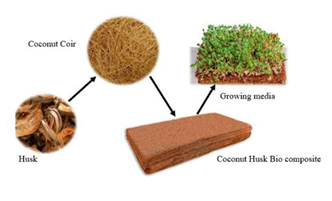
In the quest for sustainable practices, the global agriculture and environmental sectors are increasingly turning to eco-friendly materials that align with the principles of a circular economy. Among these, coco peat—a byproduct of coconut processing—stands out as a versatile, renewable, and highly sustainable resource with applications that extend far beyond traditional agriculture. Derived from the husks of coconuts, coco peat (also known as coir pith) offers a compelling blend of low cost, biodegradability, and recyclability, making it a powerful tool for addressing pressing environmental challenges. This article explores the multifaceted benefits of coco peat, linking its utility in agriculture, environmental remediation, and industrial applications to its role in fostering a more sustainable plane.
The Composition and Properties of Coco Peat.
Coco peat is derived from the fibrous husk of coconuts, a byproduct of coconut processing that would otherwise go to waste. Composed of 35.0% cellulose, 25.2% lignin, and various other organic components, coco peat is rich in functional groups such as hydroxyl, carboxyl, ether, phosphate, and amino groups. These chemical properties make it an excellent natural sorbent, capable of absorbing and retaining liquids, including water and hydrocarbons. Its high porosity, low density, and biodegradability further enhance its suitability for a wide range of applications, from soil enhancement to environmental cleanup.
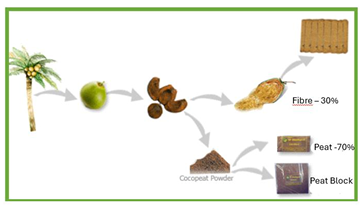
Coco peat is widely recognized in agriculture and horticulture for its ability to improve soil health and reduce reliance on chemical inputs. Its high-water retention capacity (up to 8-10 times its weight) and excellent aeration properties make it an ideal growing medium for crops, particularly in water scarce regions like the Middle East and in arid climate. By incorporating coco peat into soil or using it as a standalone substrate, farmers can:
- Reduce Water Usage: Coco peat’s water-holding capacity minimizes irrigation needs, a critical advantage in regions facing water scarcity.
- Enhance Soil Structure: Its aeration properties promote root growth, improving plant health and yield without synthetic fertilizers.
- Support Organic Farming: As a biodegradable and renewable resource, coco peat aligns with organic farming standards, reducing environmental impact.
For coconut exporters, integrating coco peat production into their operations can create a secondary revenue stream while supporting sustainable agriculture in destination markets like the UAE.
Environmental Remediation: Coco Peat as a Biosorbent
One of the most promising yet underutilized applications of coco peat is its role as a natural biosorbent for environmental cleanup, particularly in oil spill management. Research highlights coco peat’s ability to absorb hydrocarbons, such as diesel, from marine environments, offering a low-cost, eco-friendly alternative to synthetic sorbents like polypropylene. Its functional groups enable it to bind with oil molecules, making it highly effective in oil spill cleanup through filter-based systems. Key advantages include:
- Eco-Friendliness: Unlike synthetic sorbents, coco peat is biodegradable and non-toxic, minimizing secondary environmental harm.
- Cost-Effectiveness: As a byproduct of coconut processing, coco peat is abundant and inexpensive, especially in coconut-producing regions like Indonesia.
- Ease of Deployment: Its lightweight nature and compatibility with existing cleanup technologies make it practical for large-scale applications.
This aligns with global efforts to mitigate marine pollution, particularly in busy shipping routes like the Indian Ocean, where oil spills are a concern. Beyond oil spill management, coco peat’s sorbent properties make it a valuable tool for wastewater treatment and soil restoration. Its ability to adsorb heavy metals, organic pollutants, and excess nutrients from water makes it a natural fit for treating agricultural runoff or industrial wastewater. In soil restoration, coco peat can:
- Remediate Degraded Soils: By improving soil structure and nutrient retention, it helps restore degraded or saline soils, common in arid regions.
- Reduce Chemical Dependency: Its organic composition reduces the need for synthetic soil amendments, lowering environmental footprints.
The Broader Impact of Coco Peat
Coco peat’s versatility makes it a cornerstone of sustainable innovation. Its applications in agriculture, environmental remediation, and wastewater treatment address critical global challenges, including water scarcity, soil degradation, and marine pollution. For coconut exporters, integrating coco peat into their operations not only enhances profitability but also contributes to a greener planet.
As research continues to unlock coco peat’s potential, its role in replacing synthetic, non-biodegradable materials grows stronger. By adopting coco peat widely, industries can reduce waste, lower carbon footprints, and promote a circular economy—all while leveraging a resource that nature has provided in abundance.
In conclusion, Coco peat is more than a byproduct; it is a testament to the power of sustainable innovation. From enhancing agricultural productivity to cleaning up oil spills and restoring degraded soils, its applications are as diverse as they are impactful. As the world embraces greener practices, coco peat stands ready to lead the way—a natural, renewable, and powerful ally in building a sustainable future.
For an obligation free complimentary consultation, feel free to connect with us on how we can
help you!
Regards
Rashmi
Sustainability #CocoPeat #CircularEconomy #EcoInnovation #GreenTech #EnvironmentalSolutions